
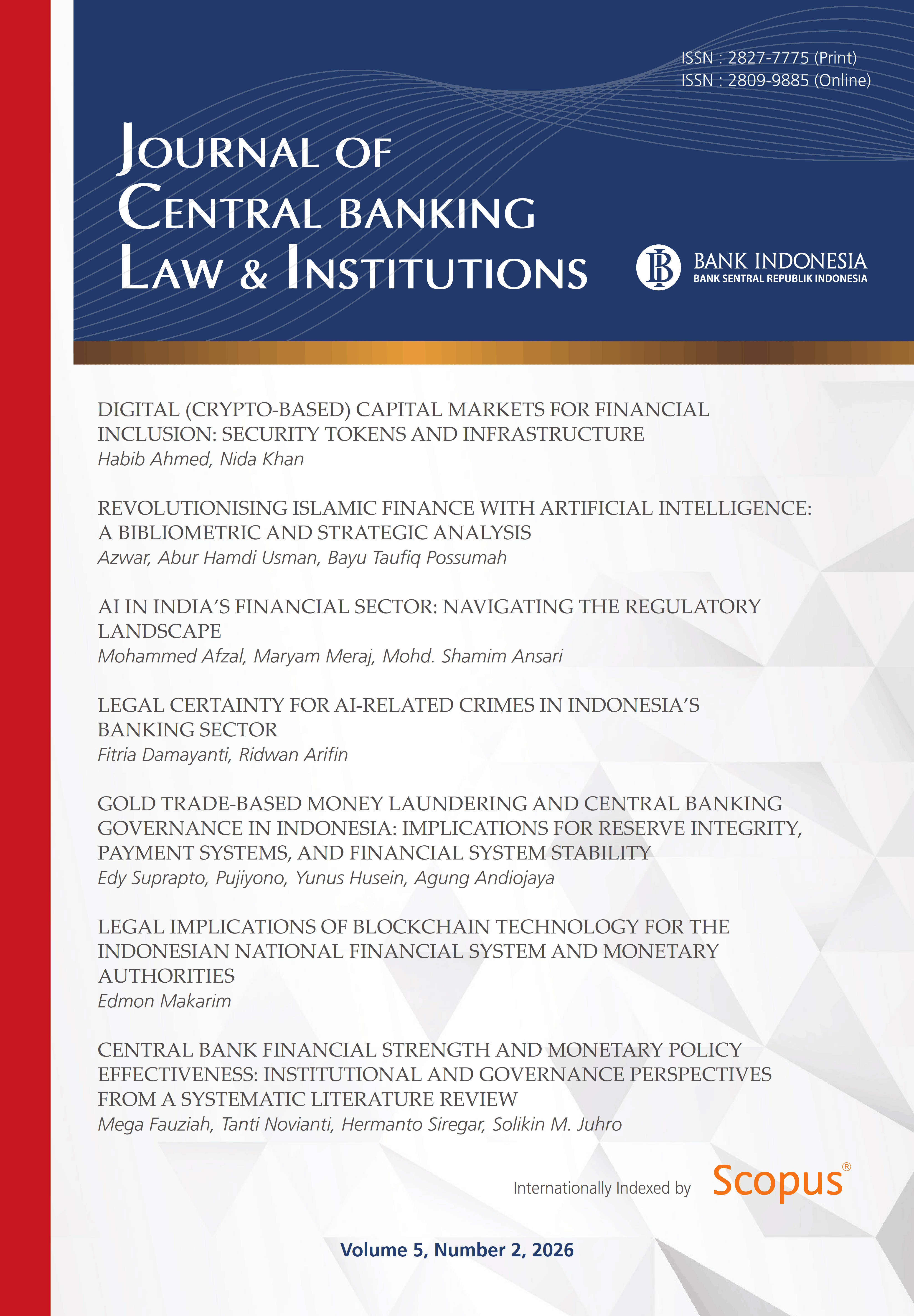
Revolutionising Islamic Finance with Artificial Intelligence: A Bibliometric and Strategic Analysis
##plugins.themes.academic_pro.article.sidebar##

Downloads
##plugins.themes.academic_pro.article.main##
Abstract
This study examines the development of Artificial Intelligence (AI) research in Islamic finance and analyses its regulatory and institutional implications for central banks and financial supervisory authorities. Specifically, the study maps scholarly trends on AI-enabled Islamic finance and assesses regulatory strengths, weaknesses, opportunities, and threats faced by public financial authorities in governing AI adoption. Using bibliometric analysis of Scopus-indexed publications from 2017 to 2024, the study identifies research trends, key contributors, institutional affiliations, and thematic evolution in this field. The findings show a steady increase in scholarly output, with 47 publications over the past decade, led by authors including Shahnawaz Khan and Mohammad Irfan, and significant contributions from institutions in Malaysia and Bahrain. Topic mapping reveals that AI adoption in Islamic finance is increasingly associated with innovation, blockchain integration, and sustainable development, raising significant regulatory concerns. To support this objective, a SWOT analysis is employed and reframed as a regulatory and institutional assessment that evaluates how central bank innovation mandates and supervisory instruments constitute strengths and opportunities, while legal uncertainty, algorithmic bias, data protection, and supervisory capacity represent key weaknesses and threats. The study concludes that although AI holds substantial potential to enhance efficiency and governance in Islamic finance, its effective deployment depends on coherent regulatory frameworks, strengthened coordination between central banks and Sharia authorities, and sustained capacity-building to manage emerging legal and institutional risks.
##plugins.themes.academic_pro.article.details##
References
- Ahmad, Tanveer, Dongdong Zhang, Chao Huang, et al. “Artificial Intelligence in Sustainable Energy Industry: Status Quo, Challenges and Opportunities.” Journal of Cleaner Production 289 (2021): 125834. https://doi.org/10.1016/j.jclepro.2021.125834.
- Alhitmi, Hitmi Khalifa, Alin Mardiah, Khalid Ibrahim Al-Sulaiti, and Jaffar Abbas. “Data Security and Privacy Concerns of AI-Driven Marketing in the Context of Economics and Business Field: An Exploration into Possible Solutions.” Cogent Business & Management 11, no. 1 (2024): 2393743. https://doi.org/10.1080/23311975.2024.2393743.
- Amato, Alessandra, Joerg R. Osterrieder, and Marcos R. Machado. “How Can Artificial Intelligence Help Customer Intelligence for Credit Portfolio Management? A Systematic Literature Review.” International Journal of Information Management Data Insights 4, no. 2 (2024): 100234. DOI: https://doi.org/10.1016/j.jjimei.2024.100234.
- Borgman, Christine L., and Jonathan Furner. “Scholarly Communication and Bibliometrics.” Annual Review of Information Science and Technology 36, no. 1 (2002): 1–53.
- Chadegani, Arezoo Aghaei, Hadi Salehi, Melor Md Yunus, et al. “A Comparison between Two Main Academic Literature Collections: Web of Science and Scopus Databases.” Asian Social Science 9, no. 5 (2013).DOI: https://doi.org/10.5539/ass.v9n5p18.
- Donthu, Naveen, Satish Kumar, Debmalya Mukherjee, Nitesh Pandey, and Weng Marc Lim. “How to Conduct a Bibliometric Analysis: An Overview and Guidelines.” Journal of Business Research 133 (2021): 285–96. https://doi.org/10.1016/j.jbusres.2021.04.070.
- Eck, Nees Jan Van, and Ludo Waltman. VOSviewer Manual: Manual for VOSviewer Version 1.6.18. Universitet Leiden and CWTS Meaningful Metrics, 2022.
- Falagas, Matthew E., Eleni I. Pitsouni, George A. Malietzis, and Georgios Pappas. “Comparison of PubMed, Scopus, Web of Science, and Google Scholar: Strengths and Weaknesses.” The FASEB Journal 22, no. 2 (2008): 338–42. DOI: https://doi.org/10.1096/fj.07-9492LSF.
- Fares, Omar H., Irfan Butt, and Seung Hwan Mark Lee. “Utilization of Artificial Intelligence in the Banking Sector: A Systematic Literature Review.” Journal of Financial Services Marketing, 8 (2023): 835-852. DOI: https://doi.org/10.1057/s41264-022-00176-7 2022,1.
- Galaz, Victor, Miguel A. Centeno, Peter W. Callahan, et al. “Artificial Intelligence, Systemic Risks, and Sustainability.” Technology in Society 67 (2021): 101741. https://doi.org/10.1016/j.techsoc.2021.101741.
- Gera, Rajat, Priyanka Chadha, Ashima Saxena, and Saurav Dixit. “A Scientometric and Bibliometric Review of Impacts and Application of Artificial Intelligence and Fintech for Financial Inclusion.” In Artificial Intelligence, Fintech, and Financial Inclusion, edited by Rajat Gera, Djamchid Assadi, and Marzena Starnawska. CRC Press, 2024. https://doi.org/10.1201/9781003125204.
- González-Sendino, Rubén, Emilio Serrano, Javier Bajo, and Paulo Novais. “A Review of Bias and Fairness in Artificial Intelligence.” International Journal of Interactive Multimedia and Artificial Intelligence 9, no. 1 (2023): 5-17. https://doi.org/10.9781/ijimai.2023.11.001
- Gupta, Brij Mohon, and Sujit Bhattacharya. “Bibliometric Approach towards Mapping the Dynamics of Science and Technology.” DESIDOC Journal of Library & Information Technology 24, no. 1 (2004). https://doi.org/10.14429/dbit.24.1.3616.
- Hassan, M. Kabir, Ammar Jreisat, Mustafa Raza Rabbani, and Somar Al-Mohamed. “Islamic Fintech and Bahrain: An Opportunity for Global Financial Services.” In Fintech in Islamic Financial Institutions: Scope, Challenges, and Implications in Islamic Finance, edited by M. Kabir Hassan, Mustafa Raza Rabbani, and Mamunur Rashid. Springer Books, 2022. https://doi.org/10.1007/978-3-031-14941-2_4
- Hentzen, Janin Karoli, Arvid Hoffmann, Rebecca Dolan, and Erol Pala. “Artificial Intelligence in Customer-Facing Financial Services: A Systematic Literature Review and Agenda for Future Research.” International Journal of Bank Marketing 40, no. 6 (2022): 1299–1336. https://doi.org/10.1108/IJBM-09-2021-0417.
- Irfan, Mohammad, Seifedine Kadry, Muhammad Sharif, and Habib Ullah Khan. Fintech Applications in Islamic Finance: AI, Machine Learning, and Blockchain Techniques. IGI Global, 2023. https://doi.org/10.4018/979-8-3693-1038-0.
- Kanaparthi, Vijaya. “Transformational Application of Artificial Intelligence and Machine Learning in Financial Technologies and Financial Services: A Bibliometric Review.” ArXiv:2401.15710 13, no. 3 (2024). https://doi.org/10.48550/arXiv.2401.15710.
- Kasim, Raja Suzana Raja, and Wan Fariza Azima Che Azman. “Sustainable Entrepreneurship Model in Islamic Fintech: A Systematic Literature Review.” Journal of Humanities and Social Sciences Research, 2023. https://doi.org/10.37534/BP.JHSSR.2023.V5.N1.ID1200.P9.
- Kordzadeh, Nima, and Maryam Ghasemaghaei. “Algorithmic Bias: Review, Synthesis, and Future Research Directions.” European Journal of Information Systems 31, no. 3 (2022): 388–409. https://doi.org/10.1080/0960085X.2021.1927212.
- Kute, Dattatray Vishnu, Biswajeet Pradhan, Nagesh Shukla, and Abdullah Alamri. “Deep Learning and Explainable Artificial Intelligence Techniques Applied for Detecting Money Laundering–a Critical Review.” IEEE Access 9 (2021): 82300–317. https://doi.org/10.1109/ACCESS.2021.3086230.
- Meza, Abel, Muammer Koç, and Mohammed Saleh Al-Sada. “Perspectives and Strategies for LNG Expansion in Qatar: A SWOT Analysis.” Resources Policy 76 (2022): 102633. https://doi.org/10.1016/j.resourpol.2022.102633.
- Nasution, Muhammad Dharma Tuah Putra, Desi Astuti, Sri Rahayu, Yossie Rossanty, Ramadhan Harahap, and Ahmad Rafiki. “AI-Driven Chatbots in Halal Marketing Communication—Challenges and Opportunities.” In Global Islamic Marketing Conference, 403–21. Springer, 2023. https://doi.org/10.1007/978-981-97-5400-7_22.
- Omar, Mohd Noor, and Auwal Adam Sa’ad. “Exploring the Potential of Artificial Neural Network in Sharī ʿah Decision-Making for Digital Banking: A Literature Review.” TAFHIM: IKIM Journal of Islam and the Contemporary World 17, no. 2 (2024): 105–30. https://doi.org/10.56389/tafhim.vol17no2.5.
- Osita, Ifediora Christian, Idoko Onyebuchi, and Nzekwe Justina. “Organization’s Stability and Productivity: The Role of SWOT Analysis an Acronym for Strength, Weakness, Opportunities and Threat.” International Journal of Innovative and Applied Research 2, no. 9 (2014): 23–32.
- Pattnaik, Debidutta, Sougata Ray, and Raghu Raman. “Applications of Artificial Intelligence and Machine Learning in the Financial Services Industry: A Bibliometric Review.” Heliyon 10, no.1 (2024): e23492. https://doi.org/10.1016/j.heliyon.2023.e23492.
- Pratiwi, Ni Putu Lusiana, and Made Sudiarta. “Alternative Marketing Strategies for Low Season Period at Courtyard by Marriott Bali Seminyak Resort.” Journal of Applied Sciences in Travel and Hospitality 2, no. 2 (2019): 109–19. https://doi.org/10.31940/jasth.v2i2.1424.
- Puyt, Richard, Finn Birger Lie, and Celeste P. M. Wilderom. “Origins of SWOT Analysis.” Long Range Planning 56, no. 3 (2023): 102304. https://doi.org/10.1016/j.lrp.2023.102304.
- Rabbani, Mustafa Raza, Syed Mabruk Billah, Muneer Shaik, Mashuk Rahman, and Rhada Boujlil. “Dynamic Connectedness, Spillover, and Optimal Hedging Strategy among FinTech, Sukuk, and Islamic Equity Markets.” Global Finance Journal 58 (2023): 100901. https://doi.org/10.1016/j.gfj.2023.100901.
- Rangkuti, Freddy. Analisis SWOT Teknik Membedah Kasus Bisnis. Gramedia Pustaka Utama, 1998.
- Rosário, Albérico Travassos, and Joana Carmo Dias. “How Has Data-Driven Marketing Evolved: Challenges and Opportunities with Emerging Technologies.” International Journal of Information Management Data Insights 3, no. 2 (2023): 100203. https://doi.org/10.1016/j.jjimei.2023.100203.
- Wang, Shuang, Muhammad Asif, Muhammad Farrukh Shahzad, and Muhammad Ashfaq. “Data Privacy and Cybersecurity Challenges in the Digital Transformation of the Banking Sector.” Computers & Security 147 (2024): 104051. https://doi.org/10.1016/j.cose.2024.104051.

This work is licensed under a Creative Commons Attribution-NonCommercial-ShareAlike 4.0 International License.