
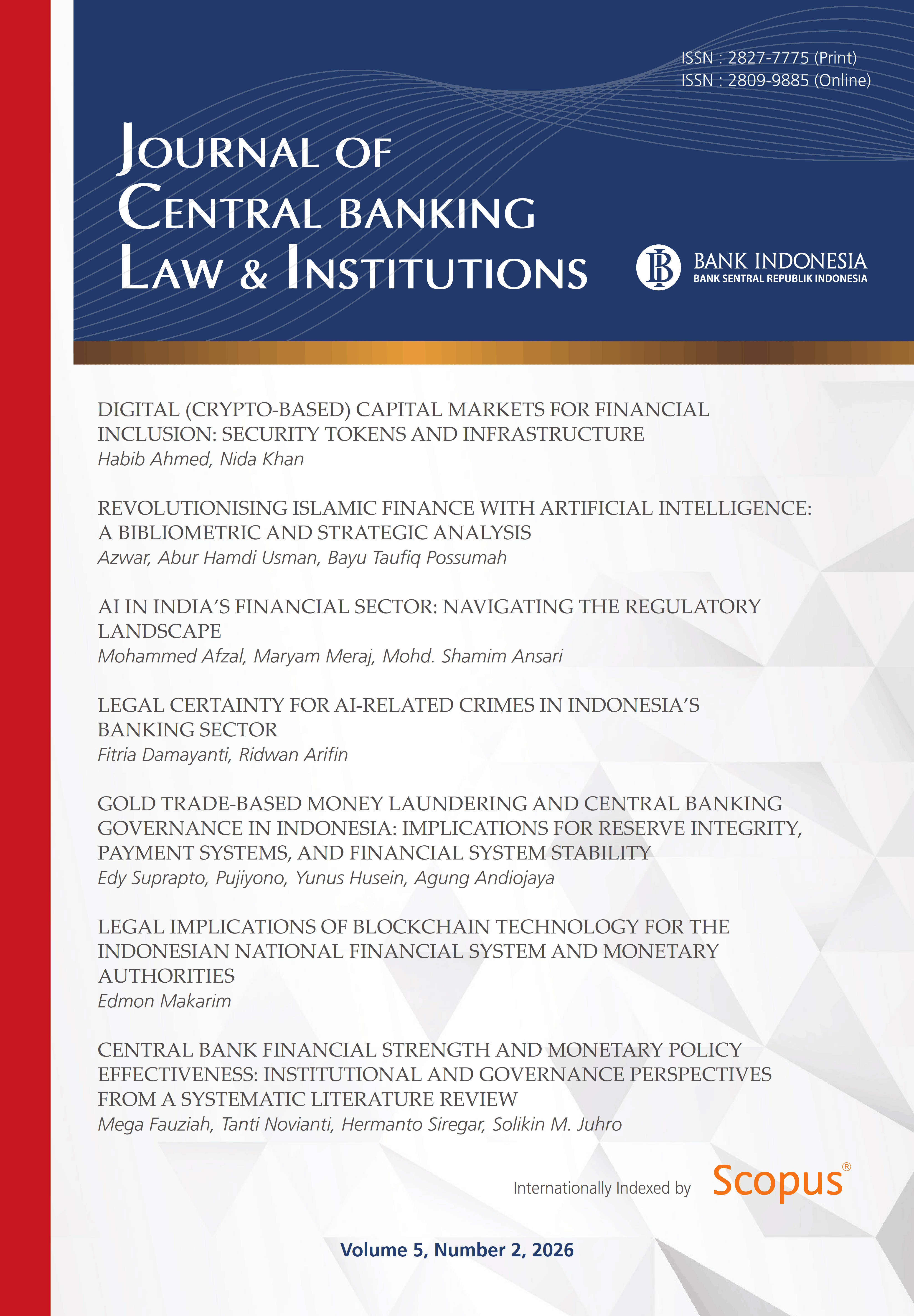
Legal Certainty for AI-Related Crimes in Indonesia’s Banking Sector
##plugins.themes.academic_pro.article.sidebar##

Downloads
##plugins.themes.academic_pro.article.main##
Abstract
As the integration of artificial intelligence (AI) into Indonesia’s rapidly evolving financial sector accelerates, the country faces critical challenges in ensuring legal certainty and protecting personal security. The rise of AI technologies in banking, fintech, and investment platforms introduces new complexities in regulatory oversight, particularly in preventing crimes such as fraud, money laundering, and cybersecurity breaches. This study examines legal certainty in the regulation of AI-related crimes in Indonesia’s banking sector and its implicationsfor personal security. The increasing use of AI in financial services has created regulatory challenges, particularly regarding personal data protection, fraud, and accountability. This research employs a normative juridical method with a statutory approach, analysing relevant Indonesian laws, including the Personal Data Protection Law, the Banking Law, the Electronic Information and Transactions Law, and the Financial Services Authority regulations. The findings reveal a legal vacuum in addressing AI-facilitated crimes, particularly regarding the allocation of responsibility and preventive mechanisms. Although existing regulations provide partial protection, they do not yet accommodate the specific risks posed by AI technologies in banking. This regulatory lacuna threatens legal certainty and personal security, particularly the right to privacy. This study highlights the urgency of developing explicit AI-related criminal laws for the financial sector to balance innovation and protection. This research is limited to doctrinal legal analysis and does not include empirical data, which may be explored in future studies.
##plugins.themes.academic_pro.article.details##
References
- Alhakim, Abdurrakhman, and Egia Ginting. “Analisis Pembentukan Undang-Undang Cipta Kerja pada Tahapan Perencanaan dan Penyusunan Berdasarkan Undang-Undang Pembentukan Peraturan Perundang-Undangan.” In Conference on Management, Business, Innovation, Education and Social Sciences (CoMBInES) (Universitas Internasional Batam, 2021), 284-96. https://garuda.kemdiktisaintek.go.id/documents/detail/3633999.
- Angkasa, Angkasa, Filep Wamafma, Ogiandhafiz Juanda, and Bhanu Prakash Nunna. “Illegal Online Loans in Indonesia: Between the Law Enforcement and Protection of Victim.” Lex Scientia Law Review 7, no. 1 (2023): 119-178. DOI: https://doi.org/10.15294/lesrev.v7i1.67558.
- Arifin, Ridwan, Juan Anthonio Kambuno, Waspiah, and Dian Latifiani. “Protecting the Consumer Rights in the Digital Economic Era: Future Challenges in Indonesia.” Jambura Law Review 3 (2021): 135–60. https://doi.org/10.33756/jlr.v3i0.9635
- Firdaus, Fahmi Ramadhan. “Pencegahan Korupsi Legislasi melalui Penguatan Partisipasi Publik dalam Proses Pembentukan Undang-Undang.” Jurnal Legislasi Indonesia 17, no. 3 (2020): 282. https://doi.org/10.54629/jli.v17i3.679.
- Jhon, Ranty Mahardika. “Existence of Criminal Law on Dealing Cyber Crime in Indonesia.” Indonesian Journal of Criminal Law Studies 3, no. 1 (2018): 2534. https://doi.org/10.15294/b69m5x33
- Gandrova, Shannon, and Ricky Banke. “Penerapan Hukum Positif Indonesia terhadap Kasus Kejahatan Dunia Maya Deepfake.” Madani: Jurnal Ilmiah Multidisiplin 1, no. 10 (2023): 650–57. https://doi.org/10.5281/zenodo.10201140.
- Ghozali, Muhammad, Nora Liana, Cut Afra, et al. “Kejahatan Siber (Cyber Crime) dan Implikasi Hukumnya : Studi Kasus Peretasan Bank Syariah Indonesia (BSI).” Cendekia: Jurnal Hukum, Sosial dan Humaniora 2, no. 4 (2024): 797–809. https://doi.org/10.70193/cendekia.v2i4.113.
- Kamel, Ibrahim. “Artificial Intelligence in Medicine.” Journal of Medical Artificial Intelligence 7, no. 4 (2024): 10–12. https://doi.org/10.21037/jmai-24-12.
- Mansur, Mochamad. “Analisis tentang Dikabulkannya Permohonan Wali Adhal atas Penetapan Pengadilan Agama.” Justitiable-Jurnal Hukum 4, no. 1(2021): 248–53. https://doi.org/10.56071/justitiable.v4i1.339.
- Novarianti, Widiya Dwi, Athalia Pranata Putri S. Meliala, Nova Arini Stevia Yusuf, and Bintang Naharika Citra Melati. “Kerahasiaan Bank vs Hak atas Informasi: Mengurai Konflik Kepentingan dalam Perlindungan Data Pribadi,” Jurnal Multidisiplin Ilmu Akademik 2, no. 1 (2025): 103–14. https://ejurnal.kampusakademik.co.id/index.php/jmia/article/view/3180.
- Prastyo, Angga, Samsul Wahidin, and Supriyadi Supriyadi. “Pengaturan Asas Keterbukaan dalam Pembentukan Undang-Undang.” Jurnal Cakrawala Hukum 11, no. 2 (2020): 125–35. https://doi.org/10.26905/idjch.v11i2.4136.
- Qayyan, Zayran Mahir, and Ramesh Kumar. “Financial Inclusion and Economic Justice: The Role of Digital Finance in Empowering Indonesia’s Poor,” Indonesian Economic Justice Review 2, no. 1 (2025): 2-5. https://doi.org/10.65815/jmdp2575.
- Rohman, M. Najibur. “Tinjauan Yuridis Normatif terhadap Regulasi Mata Uang Kripto (Crypto Currency) di Indonesia.” Jurnal Supremasi 11, no. 2 (2021): 1–10. https://doi.org/10.35457/supremasi.v11i2.1284.
- Sofyan, Muhammad Rizki, and Abdurrozzaq Hasibuan. “Transformasi Digital dalam Industri Layanan Keuangan Implikasi dan Tantangan bagi Sektor Manufaktur.” Kohesi: Jurnal Sains dan Teknologi 2, no. 4 (2024): 80–89. https://garuda.kemdiktisaintek.go.id/documents/detail/4327694.
- Waspiah, Novera Sekar, Ammirah Lies, Tegar Islami, Setyaning Wida, and Salisa Widayaning. “Model Pelindungan Hukum Data Pribadi di Era Digital Guna Menjamin Hak Warga Negara Atas Pelindungan Data Pribadi.” Syntax Literate; Jurnal Ilmiah Indonesia 8, no. 9 (2023): 5165–79. https://doi.org/10.36418/syntax-literate.v8i9.13662.
- Wijaya, Putra, and H. B. Gusliana. “Relevansi Hak Privasi dalam Undang-Undang Nomor 19 Tahun 2016 tentang Perubahan atas Undang-Undang Nomor 11 Tahun 2008 Tentang Informasi dan Transaksi Elektronik dengan Pasal 28 G Ayat 1 Undang-Undang Dasar Negara Republik Indonesia Tahun 1945.” Jurnal Ilmiah Wahana Pendidikan 10, no. 22 (2024): 662-672, https://doi.org/10.5281/zenodo.14574771.
- Yahya, M. Yusuf, and Harwis Alimuddin. “Roscou Pound: Hukum sebagai Alat Rekayasa Sosial (Keterhubungannya dengan Kaidah La Yunkaru Tagayyur Al-Ahkam Bi Tagayyuri Azzaman).” Indonesian Journal of Shariah and Justice 2, no. 2 (2022): 141–61. https://doi.org/10.46339/ijsj.v2i2.22.
- Yusuf, Moh. “Kekosongan Hukum pada Penyiaran di Media Sosial.” Tadulako Master Law Journal 8, no. 3 (2024): 243, https://garuda.kemdiktisaintek.go.id/documents/detail/5718110.

This work is licensed under a Creative Commons Attribution-NonCommercial-ShareAlike 4.0 International License.