
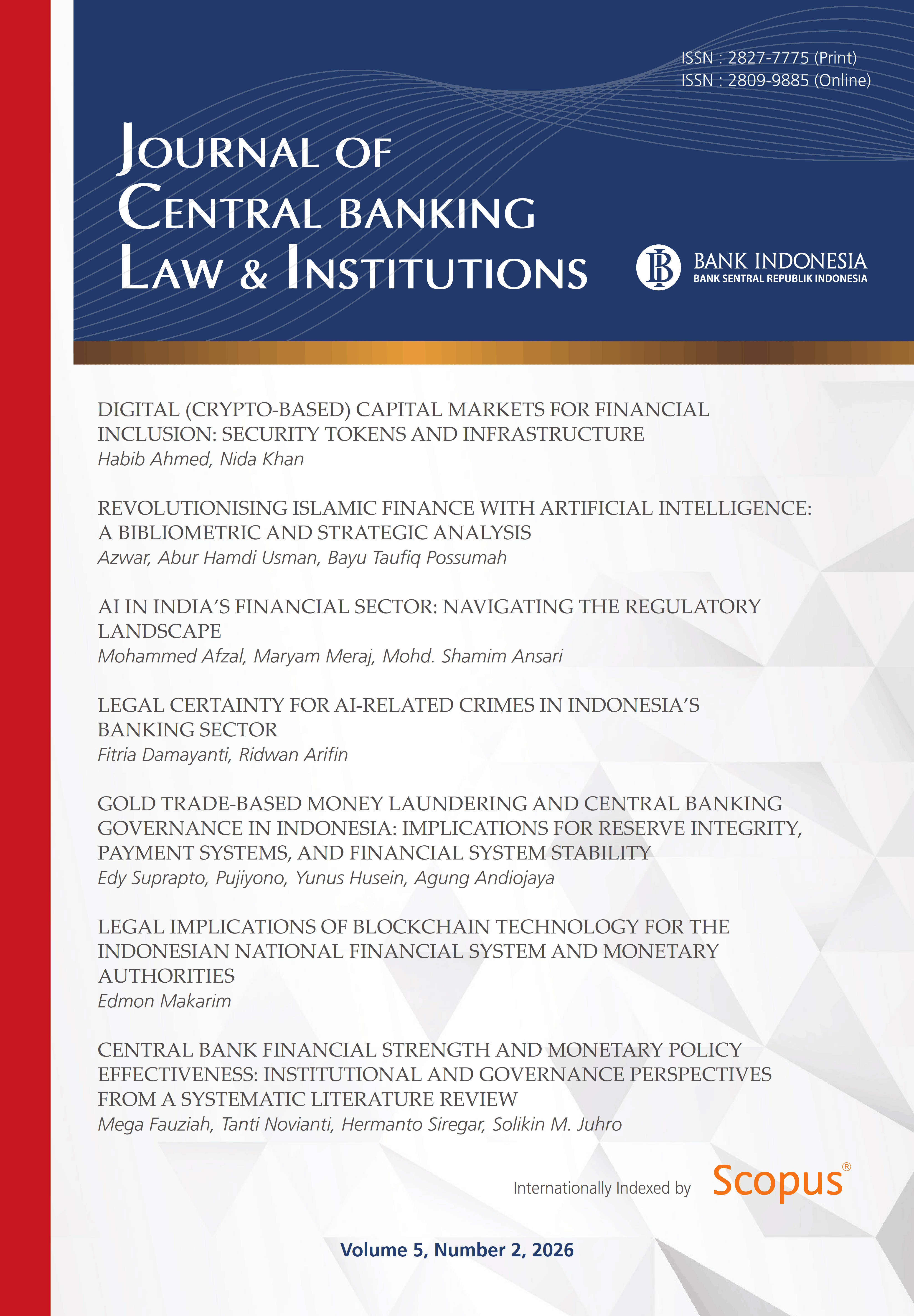
Gold Trade-Based Money Laundering and Central Banking Governance in Indonesia: Implications for Reserve Integrity, Payment Systems, and Financial System Stability
##plugins.themes.academic_pro.article.sidebar##

Downloads
##plugins.themes.academic_pro.article.main##
Abstract
Trade-based money laundering (TBML) has increasingly exploited commodities markets, including gold trading, to disguise illicit cross-border financial flows. In Indonesia, the growing integration of gold markets with the financial system has created vulnerabilities that threaten the financial system’s integrity, endangering its stability and effective central bank governance. This paper examines how TBML using gold affects key domains of central bank oversight in Indonesia, particularly reserve integrity, payment system monitoring, and financial system stability. The study employs a legal-institutional analytical approach, combining regulatory analysis with an institutional examination of central banking mandates and anti-money-laundering governance frameworks. The findings indicate that using gold to facilitate TBML can obscure the traceability of cross-border financial transactions, complicate monitoring of payment systems, and potentially weaken safeguards related to reserve management and financial system oversight. These vulnerabilities create governance challenges for financial authorities responsible for maintaining financial system integrity. From a normative legal perspective, the study highlights the need for strengthened regulatory coordination, improved oversight of gold-related financial transactions, and enhanced integration between supervision of Anti-Money Laundering and Combating the Financing of Terrorism (AML/CFT) measures and central bank regulatory design. Such measures are essential for safeguarding the integrity of the reserves and supporting the stability of the financial system.
##plugins.themes.academic_pro.article.details##
References
- Arslanalp, Serkan, Barry Eichengreen, and Chima SimpsonBell. “Gold as International Reserves: A Barbarous Relic No More?” Journal of International Economics 145 (2023): 103822. https://doi.org/10.1016/j.jinteco.2023.103822.
- Bank for International Settlements, ed. Sound Management of Risks Related to Money Laundering and Financing of Terrorism. Jan. 2014. Basel: BIS, 2014.
- Basel Committee on Banking Supervision. Implications of Fintech Developments for Banks and Bank Supervisors Sound Practices. February 2018. Basel: Bank for International Settlements, 2018.
- Borio, Claudio E. V., Jannecke Ebbesen, Gabriele Galati, and Alexandra Heath. FX Reserve Management: Elements of a Framework. BIS Papers 38. Basel: Bank for International Settlements, 2008.
- Borio, Claudio, Michael Leahy, Robert N. McCauley, and Patrick McGuire. What Share for Gold? On the Interaction of Gold and Foreign Exchange Reserve Returns. BIS Working Papers No. 906. Bank for International Settlements, 2020.
- Brandt, Kasper. “Illicit Financial Flows and Developing Countries: A Review of Methods and Evidence.” Journal of Economic Surveys 37, no. 3 (2023): 789–820. https://doi.org/10.1111/joes.12518.
- Braun, Virginia, and Victoria Clarke. “Using Thematic Analysis in Psychology.” Qualitative Research in Psychology 3, no. 2 (2006): 77–101. https://doi.org/10.1191/1478088706qp063oa.
- Brugger, Fritz, Tongnoma Zongo, Joschka J. Proksik, and Anna Bugmann. “Unravelling the Nexus of Illicit Gold Trade, Protection Rackets, and Political Settlement Dynamics: Evidence from Burkina Faso.” World Development 181(2024): 106682. https://doi.org/10.1016/j.worlddev.2024.106682.
- Cassara, John A. Trade-Based Money Laundering: The next Frontier in International Money Laundering Enforcement. John Wiley & Sons, 2016.
- Choi, Yeon Soo, Ian Cremer, Melissa DeJong, et al. Illicit Financial Flows via Trade Mis-Invoicing. World Customs Organization, 2018. https://www.wcoomd.org/-/media/wco/public/global/pdf/media/newsroom/reports/2018/wco-study-report-on-iffs_tm.pdf?db=web.
- Collier, Paul, and Anthony J. Venables. International Rules for Trade in Natural Resources. Working Paper ERSD-2010-06. Oxford, UK: Economic Research and Statistics Division, World Trade Organization, 2010. https://www.wto.org/english/res_e/reser_e/ersd201006_e.pdf.
- D’Souza, Jayesh. Terrorist Financing, Money Laundering, and Tax Evasion: Examining the Performance of Financial Intelligence Units. CRC Press, 2017. https://doi.org/10.1201/b11067.
- Erbenová, Michaela, Yan Liu, Nadim Kyriakos Saad, et al. The Withdrawal of Correspondent Banking Relationships: A Case for Policy Action. IMF Staff Discussion Notes (SDNs). International Monetary Fund, June 2016. https://www.imf.org/external/pubs/ft/sdn/2016/sdn1606.pdf.
- Financial Action Task Force. Methodology for Assessing Technical Compliance with the FATF Recommendations and the Effectiveness of AML/CFT/CPF Systems. FATF, 2025. https://www.fatf-gafi.org/content/dam/fatf-gafi/methodology/FATF-Assessment-Methodology-2022.pdf.coredownload.inline.pdf.
- Financial Action Task Force and the Asia/Pacific Group on Money Laundering. Money Laundering and Terrorist Financing Risks and Vulnerabilities Associated with Gold. Paris, France: FATF, 2015. https://www.fatf-gafi.org/en/publications/Methodsandtrends/Ml-tf-risks-and-vulnerabilities-gold.html.
- Financial Action Task Force and the Middle East and Africa Financial Action Task Force. Money Laundering through the Physical Transportation of Cash. Paris, France: FATF/OECD and MENAFATF, 2015. https://www.fatfgafi.org/content/dam/fatf-gafi/reports/money-laundering-throughtransportation-cash.pdf.
- Financial Action Task Force and Egmont Group. Trade-Based Money Laundering: Trends and Developments. FATF, 2020. https://www.fatf-gafi.org/en/publications/Methodsandtrends/Trade-based-money-laundering-trends-and-developments.html.
- Financial Stability Board. Global Monitoring Report on Non-Bank Financial Intermediation. FSB, 2020.
- Gevorkyan, Aleksandr V., and Tarron Khemraj. “Back to the Future: Gold in International Reserves as a New Stabilizer (Again!) of Exchange Rate Systems.” SUERF Policy Brief No. 604. SUERF: The European Money and Finance Forum, 2023. https://www.suerf.org/publications/suerfpolicy-notes-and-briefs/back-to-the-future-gold-in-international-reservesas-a-new-stabilizer-again-of-exchange-rate-systems/.
- Ginting, Yuni Priskila, and Louise Shania Sabela. “Suspicious Financial Transactions from Initial Evidence of Customs Offenses.” UNES Law Review 6, no. 4 (July 2024): 11353–61. https://doi.org/10.31933/unesrev.v6i4.2091.
- Griffin, Carroll Howard. “Gold, Bitcoin and Central Banks in the 21st Century: The New Dynamic.” International Journal of Finance 10, no. 2 (2025): 29-4. https://doi.org/10.47941/ijf.2569.
- Grynberg, Roman, and Fwasa K. Singogo. “Dubai: Conflict Gold, Money Laundering and Illicit Global Trade.” In African Gold, by Roman Grynberg and Fwasa K. Singogo, 315–55. Palgrave Macmillan, Cham, 2021. https://doi.org/10.1007/978-3-030-65995-0_10.
- Hasibuan, Ongku P., Jann H. Tjakraatmadja, and Yos Sunitiyoso. “Illegal Gold Mining in Indonesia: Structure and Causes.” International Journal of Emerging Markets 17, no. 1 (January 2022): 177–97. https://doi.org/10.1108/IJOEM-11-2019-0964.
- Hastasari, Ratih, and Suharini Suharini. “The Role of Bullion Banks as a Market Risk Management Instrument in Indonesia’s Gold Sector.” Jurnal Ilmiah Multidisiplin 4, no. 04 (July 2025): 114–19. https://doi.org/10.56127/jukim.v4i04.2195.
- Hataley, Todd. “Trade-Based Money Laundering: Organized Crime, Learning and International Trade.” Journal of Money Laundering Control 23, no. 3 (March 2020): 651–61. https://doi.org/10.1108/JMLC-01-2020-0004.
- Hong, Keejae P., and Simon J. Pak. “Estimating Trade Misinvoicing from Bilateral Trade Statistics: The Devil Is in the Details.” The International Trade Journal 31, no. 1 (2017): 3–28. https://doi.org/10.1080/08853908.2016.1202160.
- International Monetary Fund. Anti-Money Laundering and Combating the Financing of Terrorism (AML/CFT): Report on the Review of the Effectiveness of the Program. Legal Document. International Monetary Fund, 2011. https://www.imf.org/external/np/pp/eng/2011/051111.pdf.
- International Monetary Fund. Financial Intelligence Units: An Overview. Washington, D.C: International Monetary Fund, 2004. https://doi.org/10.5089/9781589063495.069.
- International Monetary Fund. Revised Guidelines for Foreign Exchange Reserve Management. International Monetary Fund, 2014. https://www.imf.org/external/np/mae/ferm/2014/revgudferm14.pdf.
- Ing, Lili Yan, Gordon H. Hanson, and Mulyani Indrawati. The Indonesian Economy: Trade and Industrial Policies. 1st ed. Routledge, 2017. https://doi.org/10.4324/9781315161976.
- Isayev, Mugabil. “Financial Inclusion and Economic Growth: The Role of Non-Bank Financial Intermediation.” International Review of Economics & Finance 105 (2026): 104829. https://doi.org/10.1016/j.iref.2025.104829.
- Jonathan, Fisher S., and Anita Clifford. The Criminal Finances Act 2017. Informa Law from Routledge, 2018. https://doi.org/10.4324/9781351053969.
- Kar, Dev, and Joseph Spanjers. Illicit Financial Flows from Developing Countries: 2004-2013. Global Financial Integrity, 2015. https://gfintegrity.org/wpcontent/uploads/2015/12/IFF-Update_2015-Final-1.pdf.
- Levi, Michael, and Peter Reuter. “Money Laundering.” Crime and Justice 34 (2006): 289–375. https://doi.org/10.1086/501508.
- Madinger, John. Money Laundering: A Guide for Criminal Investigators. 3rd ed. Taylor & Francis, 2012.
- Mathias, Emmanuel, and Bert Feys. Implementing AML/CFT Measures in the Precious Minerals Sector: Preventing Crime While Increasing Revenue. With International Monetary Fund and International Monetary Fund. Technical Notes and Manuals 14/01. Washington, D.C: International Monetary Fund, 2014.
- Nowell, Lorelli S., Jill M. Norris, Deborah E. White, and Nancy J. Moules. “Thematic Analysis: Striving to Meet the Trustworthiness Criteria.” International Journal of Qualitative Methods 16 (2017): 1-13. https://doi.org/10.1177/1609406917733847.
- Pribadi, Raden. “The Significance of the Nickel Ore Export Prohibition for Indonesia in Consolidating Its Middle-Income Status in the World System.” Master’s Thesis. Lund University, 2024. http://lup.lub.lu.se/student-papers/record/9161036.
- Ranjan, Amit, and Chulanee Attanayake. “The Bay of Bengal in the Evolving Indo-Pacific Debate.” Australian Journal of Maritime & Ocean Affairs 16, no. 3 (2024): 285–91. https://doi.org/10.1080/18366503.2024.2383820.
- Rathi, Sawan, Sanket Mohapatra, and Arvind Sahay. “Central Bank Gold Reserves and Sovereign Credit Risk.” Finance Research Letters 45 (2022): 102127. https://doi.org/10.1016/j.frl.2021.102127.
- Sachs, Jeffrey D., Andrew Warner, Anders Aslund, and Stanley Fischer. “Economic Reform and the Process of Global Integration.” Brookings Papers on Economic Activity 1995, no. 1 (1995): 1. https://doi.org/10.2307/2534573.
- Shin, Hyun Song. The Next-Generation Monetary and Financial System. Bank for International Settlements, 2025.
- Surbakti, Yusuf Marsel, and Maria Puspitasari. “The Threat of Illegal Imports Related to Narcotics and Cosmetics Smuggling in the Border Area of Tarakan: A Review from the Perspective of National Resilience.” Indonesian Journal of Multidisciplinary Science 4, no. 2 (2024): 116–28. https://doi.org/10.55324/ijoms.v4i2.1033.
- Teichmann, Fabian Maximilian Johannes. “Twelve Methods of Money Laundering.” Journal of Money Laundering Control 20, no. 2 (2017): 130–37. https://doi.org/10.1108/JMLC-05-2016-0018.
- Teichmann, Fabian Maximilian Johannes, and Marie-Christin Falker. “Money Laundering – the Gold Method.” Journal of Money Laundering Control 26, no. 3 (2023): 509–22. https://doi.org/10.1108/JMLC-07-2019-0060.
- Tijaja, Julia, and Mohammad Faisal. Industrial Policy in Indonesia: A Global Value Chain Perspective. Nos. WPS146901-3. Manila, Philippines: Asian Development Bank, 2014. https://www.adb.org/sites/default/files/publication/110982/ewp-411.pdf.
- Unger, Brigitte, Joras Ferwerda, Melissa van den Broek and Ioana Deleanu. The Economic and Legal Effectiveness of the European Union’s Anti-Money Laundering Policy. Edward Elgar Publishing Limited, 2014. https://doi.org/10.4337/9781783472772.
- Unger, Brigitte, and Joras Ferwerda. Money Laundering in the Real Estate Sector: Suspicious Properties. Edward Elgar Publishing, 2011. https://doi.org/10.4337/9781781000915.
- United Nations Interregional Crime and Justice Research Institute. Strengthening The Security and Integrity of The Precious Metals Supply Chain. Technical Report. Torino, Italy: UNICRI, 2016. https://unicri.org/sites/default/files/2019-11/Strengthening%20the%20Security%20and%20Integrity%20of%20the%20Precious%20Metals%20Supply%20Chain_0.pdf.
- Warjiyo, Perry. “Indonesia: The Macroprudential Framework and the Central Bank’s Policy Mix.” Bank of International Settlements (BIS), 2018. BIS Paper No. 94n. https://papers.ssrn.com/sol3/papers.cfm?abstract_id=3105966.
- World Bank. Central Bank Reserve Management Practices: Insights into Public Asset Management. World Bank, 2021.
- WTO. World Trade Report 2019: The Future of Services Trade. World Trade Organization, 2019.
- Zabyelina, Yuliya, and Lilla Heins. “All That Glitters: Money Laundering through Precious Metals and Minerals.” In Illegal Mining, edited by Yuliya Zabyelina and Daan Van Uhm, 439–65. Palgrave Macmillan, Cham, 2020. https://doi.org/10.1007/978-3-030-46327-4_16.
- Zulaica, Omar. “What Share for Gold? On the Role of Gold in Central Bank Reserves.” BIS Working Paper No. 906. Bank for International Settlements, 2019. https://www.bis.org/publ/work906.pdf.

This work is licensed under a Creative Commons Attribution-NonCommercial-ShareAlike 4.0 International License.
Most read articles by the same author(s)
- Yunus Husein, Ichsan Zikry, Legal and Institutional Aspects of The Financial Sector in Handling the Covid-19 Pandemic , Journal of Central Banking Law and Institutions: Vol. 1 No. 2 (2022)