
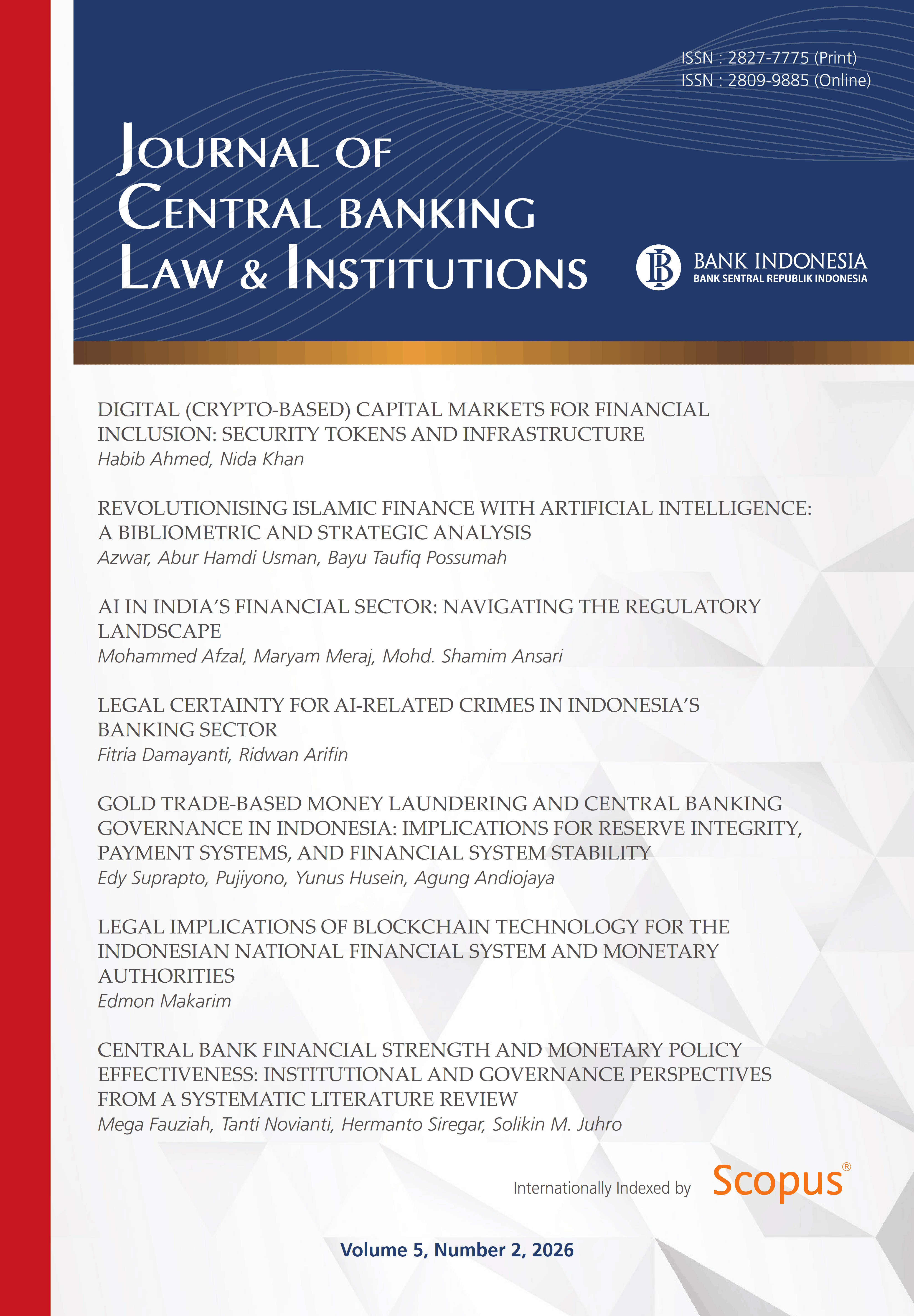
Legal Implications of Blockchain Technology for the Indonesian National Financial System and Monetary Authorities
##plugins.themes.academic_pro.article.sidebar##

Downloads
##plugins.themes.academic_pro.article.main##
Abstract
Bank Indonesia faces significant governance challenges as it integrates blockchain technology into the national financial infrastructure. While blockchain offers enhanced transparency and operational integrity, it also raises critical concerns about security, systemic vulnerabilities, and legal accountability. This doctrinal study examines blockchain deployment within the Indonesian financial system, focusing on data protection, technical risks, and the allocation of liability for system failures or breaches. Findings indicate that while decentralised architectures can bolster transactional trust, they are constrained by smart-contract vulnerabilities and interoperability issues. Legally, determining accountability in distributed networks remains problematic, especially where centralised control is absent. Consequently, the study advocates for a comprehensive, adaptive regulatory framework anchored in public institutional authority. Such a framework must align blockchain use with statutory obligations regarding data protection and payment system governance. Grounded in Indonesia’s legal structure and international standards, this approach provides a model for jurisdictions seeking to integrate blockchain into state-supervised financial systems.
##plugins.themes.academic_pro.article.details##
References
- Atzori, Marcella. “Blockchain Technology and Decentralized Governance: Is the State Still Necessary?” Journal of Governance & Regulation 6, no. 1 (2017): 45–62. https://doi.org/10.22495/jgr_v6_i1_p5.
- Bains, Parma, Arif Ismail, Fabiana Melo, and Nobuyasu Sugimoto. Regulating the Crypto Ecosystem: The Case of Unbacked Crypto Assets. IMF Fintech Note No. 2022/007. International Monetary Fund, September 2022. https://www.imf.org/-/media/files/publications/ftn063/2022/english/ftnea2022007.pdf.
- Bank for International Settlements. “The Next-Generation Monetary and Financial System.” In BIS Annual Economic Report 2025. Bank for International Settlements, 2025. https://www.bis.org/publ/arpdf/ar2025e3.pdf.
- Basel Committee on Banking Supervision (BCBS). Prudential Treatment of Cryptoasset Exposures. Basel: Bank for International Settlements, December 2022. https://www.bis.org/bcbs/publ/d545.pdf.
- Bimantara, Gesa, Tri Astuti Handayani, and M. Aqiel Alami. “Legal Analysis of Bitcoin Ownership as a Medium of Exchange in the Digital Financial System.” Hakamain: Journal of Sharia and Law Studies 4, no. 1 (2021): 64-77. https://doi.org/10.57255/hakamain.v4i1.1358.
- Cermeño, Javier Sebastian. Bitcoin and Its Potential Impact on the Financial System. Madrid: BBVA Research, 2016. https://www.bbvaresearch.com/wp-content/uploads/2016/12/WP_16-20.pdf.
- Chhunchha, Yash. “Revolutionizing Financial Institutions: The Influence of Blockchain Technology in the Banking Sector in California.” PhD diss., Westcliff University, 2025.
- CoinMarketCap. Global Crypto Market Report. 2024. https://coinmarketcap.com.
- Guo et al., “Cryptocurrencies and Central Bank Digital Currencies in Global Perspective” Journal of Risk and Financial Management Vol. 18 Issue 11, 2025 https://doi.org/10.3390/jrfm18110644
- Holloway, Samuel. “Examining the Adoption of Blockchain Technology in Financial Information Systems.” SSRN Electronic Journal, (2025). https://dx.doi.org/10.2139/ssrn.5121823
- Hugo, Alonel. “Private Blockchain-Based Procurement and Asset Management System with QR Code.” SSRN Electronic Journal, January. (2024) https://doi.org/10.2139/ssrn.4918938
- Iansiti, Marco, and Karim R. Lakhani. “The Truth about Blockchain.” Harvard Business Review 95, no. 1 (2017): 118–127. https://hbr.org/2017/01/thetruth-about-blockchain.
- International Monetary Fund. Global Financial Stability Report: The Last Mile: Financial Vulnerabilities and Risk. Washington, D.C.: International Monetary Fund, April 2024. https://www.imf.org/en/publications/gfsr/issues/2024/04/16/global-financial-stability-report-april-2024.
- International Telecommunication Union. Digital Financial Services: Regulating for Financial Inclusion–an ICT Perspective. ITU, 2016.
- Khiaonarong, Tanai, and Terry Goh. “Fintech and Payments Regulation: Analytical Framework.” IMF Working Paper WP/20/75, International Monetary Fund, Washington, D.C., May 2020. https://www.imf.org/-/media/files/publications/wp/2020/english/wpiea2020075-print-pdf.pdf
- Koonprasert, Tayo Tunyathon, Shiho Kanada, Natsuki Tsuda, and Edona Reshidi, “Central Bank Digital Currency Adoption: Inclusive Strategies for Intermediaries and Users”, Fintech Notes 2024, No. 005, Washington, DC: International Monetary Fund, 2024, https://doi.org/10.5089/9798400289422.063
- Lytvyn, Olena, Volodymyr Kudin, Andrii Onyshchenko, Mykyta Nikolaiev, and Natalia Chaplynska. “Integration of Digital Means in the Financial Sphere: The Potential of Cloud Computing, Blockchain, Big Data and AI. ” Financial and Credit Activity: Problems of Theory and Practice 1, no. 54 (2024): 128–145. https://doi.org/10.55643/fcaptp.1.54.2024.4257.
- Mahdani, Rimal, and Dara A. Soufyan. “Blockchain and AI in Combating Financial Corruption: A Systematic Literature Review.” Journal of Central Banking Law and Institutions 5, no. 1 (2026): 125–152.
- Movanu, Luminita. “Blockchain for an Efficient Public Administration”. Perspective Politice 16, (January, 2023). https://doi.org/10.25019/perspol/23.16.0.13
- Nabilou, Hossein. “Bitcoin Governance as a Decentralized Financial Market Infrastructure.” Stanford Journal of Blockchain Law & Policy 4, no. 2 (2021): 197–240. https://hdl.handle.net/11245.1/baf416c7-5ed7-4b61-8a22-d70d91336bc1.
- Nakamoto, Satoshi. Bitcoin: A Peer-to-Peer Electronic Cash System. 2008. https://bitcoin.org/bitcoin.pdf.
- OECD. Competition, Fintechs, and Open Banking: An Overview of Recent Developments in Latin America and the Caribbean. OECD Roundtables on Competition Policy Papers No. 313. Paris: OECD Publishing, 2024.
- Pal, et.al., “Innovation on Credit: The Role of Fintech and Institutional Quality in Global Technological Advancements” Journal of Innovation and Entrepreneurship Vol. 14 Issue 1, 2025 https://doi.org/10.1186/s13731-025-00568-8
- Pavlov, Roman, Olena Zarutska, Tatyana Pavlova, Tatyana Grynko, Oksana Levkovich, and Liudmyla Hordieieva-Herasymova. “Blockchain as a Management Technology: Institutionalization of Crypto-Assets and Transformation of Entrepreneurial Models Using the Example of Ethereum.” Financial and Credit Activity: Problems of Theory and Practice 6, no. 59 (2024): 151–66.
- Pestovska, Zoriana S. “(R)evoliutsiia bankinhu: Dyskusii ta perspektyvy [(Р)Еволюція Банкінгу: Дискусії tа Перспективи,” Academy Review [Пестовська] 1, no. 54 (2021): 37–47. https://doi.org/10.32342/2074-5354-2021-1-54-4.
- Putra, Diky Pratama, and Pujiyono Suwadi, “The Legal and System Security hurdles in Implementing Electronic-Based Government System at the Department Population and Civil Registration in Indonesia.” Advances in Social Sciences, Education and Humanities Research, Proceedings of the International Conference on Cultural Policy and Sustainable Development, (2024): 612-619.
- Republik Indonesia. Law No. 11 of 2008. 2008.
- Republik Indonesia. Law No. 21 of 2011 on the Financial Services Authority. 2011.
- Republik Indonesia. Law No. 23 of 1999 on Bank Indonesia. 1999.
- Republik Indonesia. Law No. 27 of 2022 on Personal Data Protection. 2022.
- Republik Indonesia. Government Regulation No. 71 of 2019 on the Implementation of Electronic Systems and Transactions. 2019.
- Scheltz, et. al. “Blockchain and Regenerative Finance: Charting a Path toward Regeneration.” Frontiers in Blockchain, ( July, 2023), 7 https://doi.org/10.3389/fbloc.2023.1165133
- Shah, M.A., and Navneet Raj, “Examining the role of blockchain and public-private partnerships in design and deployment of blockchainenabled CBDC” Digital Business Vol. 5 Issue 1, (June, 2025). https://doi.org/10.1016/j.digbus.2025.100111
- Shoetan, Philip Olaseni, and Babajide Tolulope Familoni. “Blockchain’s Impact on Financial Security and Efficiency.” International Journal of Management & Entrepreneurship Research 6, no. 4 (2024): 1213.
- Swan, Melanie. Blockchain: Blueprint for a New Economy. O’Reilly Media, 2015.
- Tan, Evrim, Stanislav Mahula, and Joep Crompvoets. “Blockchain Governance in the Public Sector: A Conceptual Framework for Public Management.” Government Information Quarterly 39, no. 1 (2022): 101625. https://doi.org/10.1016/j.giq.2021.101625.
- Tsouris, Ioannis, Georgios L. Thanasas, Maria Rigou, “Assessing the European Central Bank’s Institutional Capacity Readiness for the Introduction of the Digital Euro” Journal of Risk and Financial Management Vol. 19 Issue 2, (February, 2026), https://doi.org/10.3390/jrfm19020148
- Udeh, Ezekiel Onyekachukwu, et al. “The Role of Blockchain Technology in Enhancing Transparency.” Finance & Accounting Research Journal 6, no. 6 (2024): 836.
- Zafar, Ammar. “Privacy as institutional design: A legal-technological analysis of CBDC governance and compliance”, Computer Law and Security Review. (April, 2026). https://doi.org/10.1016/j.clsr.2025.106258
- Zhang, Tao, and Zhigang Huang. “Blockchain and Central Bank Digital Currency.” ICT Express 8, no. 2 (2022): 264-70. https://doi.org/10.1016/j.icte.2021.09.014.

This work is licensed under a Creative Commons Attribution-NonCommercial-ShareAlike 4.0 International License.