
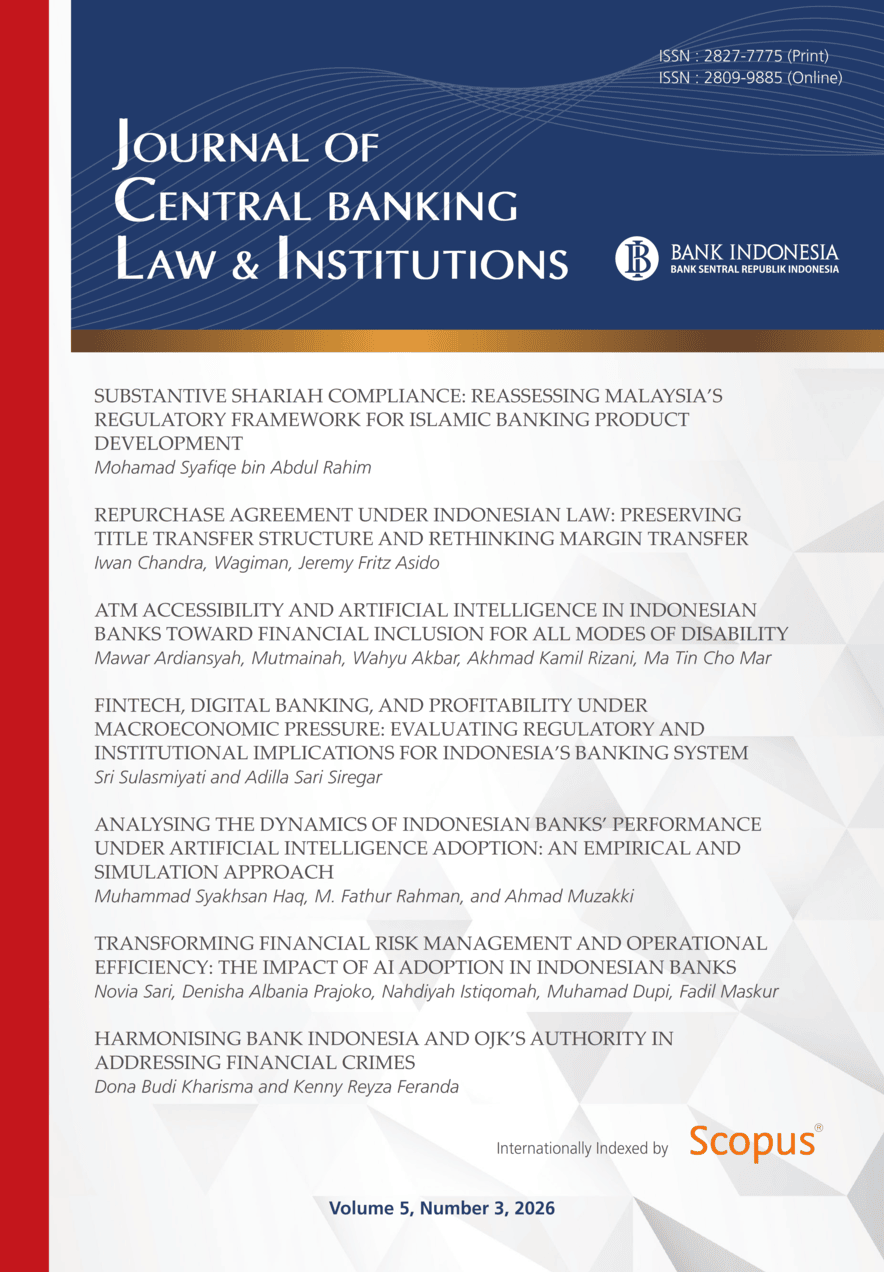
The Repurchase Agreement Under Indonesian Law: Preserving Title Transfer Structure and Rethinking Margin Transfer
##plugins.themes.academic_pro.article.sidebar##

Downloads
##plugins.themes.academic_pro.article.main##
Abstract
Repurchase agreements play an important role in modern financial markets by providing shortterm liquidity through the transfer of securities coupled with an obligation to repurchase equivalent securities at a later date. In Indonesia, however, legal uncertainty remains in two closely connected respects. First, a repurchase agreement may be recharacterised as a collateralised loan rather than a true sale and repurchase transaction, with significant consequences for the legal status of the securities, the parties’ rights, and enforcement. Second, margin transfers in repurchase agreements raise a distinct doctrinal question under Indonesian law, particularly regarding how such transfers can be accommodated without undermining the transaction’s title-transfer structure. This study employs normative legal research, drawing on statutory, conceptual, and comparative approaches. It examines the Indonesian regulatory framework governing repurchase agreements, relevant principles of Indonesian private law on transfer of rights and security interests, and comparative developments in financial collateral law. This article argues that the risk of recharacterisation may be reduced through clearer contractual drafting, conceptual consistency, and appropriate dispute resolution mechanisms. It further argues that although classical pledges may appear to offer a familiar analogy for margin transfers, relying on pledges as the legal basis for repurchase agreement margining risks blurring the distinction between repurchase agreements and collateralised loans and may therefore increase recharacterisation risk. The preferable approach is to preserve the titletransfer logic of repurchase agreement documentation by relying, in the short term, on selland-buyback mechanisms available within the repurchase agreement framework, while, in the longer term, Indonesia would benefit from a regulatory framework dedicated to financial collateral.
##plugins.themes.academic_pro.article.details##
References
- European Union. Council Directive 2002/47/EC of 6 June 2002 on Financial Collateral Arrangements. Official Journal of the European Communities L 168 (June 27, 2002).
- Indonesia. Civil Code (Burgerlijk Wetboek).
- ———. Law No. 30 of 1999 on Arbitration and Alternative Dispute Resolution. 1999.
- ———. Law No. 37 of 2004 on Bankruptcy and Suspension of Debt Payment Obligations. 2004.
- ———. Law No. 4 of 2023 on the Development and Strengthening of the Financial Sector. 2023.
- ———. Law No. 4 of 2026 on the Amendment to Law No. 4 of 2023 concerning the Development and Strengthening of the Financial Sector. 2026.
- ———. Otoritas Jasa Keuangan (OJK). Regulation No. 9/POJK.04/2015 on Guidelines for Repurchase Agreement Transactions for Financial Services Institutions. 2015.
- ———. OJK. Circular Letter No. 33/SEOJK.04/2015 on Indonesia Global Master Repurchase Agreement. 2015.
- Netherlands. Dutch Civil Code (Burgerlijk Wetboek). Book 7, Chapter 7.2 (Articles 7:51-7:56) on Financial Collateral Arrangements.
- Indonesia. South Jakarta District Court. Decision No. 618/Pdt.G/2016/PN JKT.SEL. 21 November 2017.
- ———. Jakarta High Court. Decision No. 314/PDT/2018/PT.DKI. 9 July 2018.
- Corradin, Stefano, and Angela Maddaloni. “The Importance of Being Special: Repo Markets During the Crisis.” Journal of Financial Economics 137, no. 2 (2020): 392–429. https://doi.org/10.1016/j.jfineco.2020.02.006.
- Ezike, Obiora. “Identifying a System-Neutral Meaning of a Title Transfer Financial Collateral Arrangement in the Financial Collateral Directive,” Uniform Law Review 26, no. 3 (2021): 554–582. DOI: https://doi.org/10.1093/ulr/unab023.
- ———, “The EU Financial Collateral Directive: The Distinguishing Features of a Security Financial Collateral Arrangement?” Uniform Law Review 27, no. 3 (August 2022): 460–471. DOI: https://doi.org/10.1093/ulr/unac025.
- Gabor, Daniela. “The (Impossible) Repo Trinity: The Political Economy of Repo Markets.” Review of International Political Economy 23, no. 6 (2016): 967–1000. https://doi.org/10.1080/09692290.2016.1207699.
- Fairhurst, Douglas, and Yoonsoo Nam. “Collateral Constraints, Financial Constraints, and Risk Management: Evidence from Anti-Recharacterization Laws.” Journal of Financial and Quantitative Analysis 58, no. 2 (2023): 805-836. https://doi.org/10.1017/S0022109022000254
- Keijser, Thomas. “From Intermediated Securities to Digital Assets: The Debate on Collateral Transactions.” Uniform Law Review 30, no. 2 (2025): 143–151. https://doi.org/10.1093/ulr/unaf031.
- Meneghini, Luca. “The Legal and Economic Underpinnings of Repo Transactions: A Comparative Overview.” Rivista di Diritto del Risparmiono. 3 (2019): 38–63. https://www.dirittodelrisparmio.it/wp-content/uploads/2020/05/Rivista-di-Diritto-del-Risparmio-Fascicolo-3_2019.pdf
- Paech, Philipp. “The Value of Financial Market Insolvency Safe Harbours, Oxford Journal of Legal Studies 36, no. 4 (2016): 855–884. DOI: https://doi.org/10.1093/ojls/gqv041.
- Schwarcz, Steven L., and Isabelle Stewart. “Recharacterizing Contracts: The Sale-versus-Loan Problem of Receivables Financing.” American Bankruptcy Law Journal 100 (2026): 68–115
- Tot, Ivan. “Financial Market Lex Mercatoria and Its Influence on the Financial Collateral Directive.” InterEULawEast: Journal for theInternational and European Law, Economics and Market Integrations 5, no. 1 (2018): 37-72. https://doi.org/10.22598/iele.2018.5.1.3.
- Tot, Ivan. “The Risk of Re-characterization of Title Transfer Financial Collateral Arrangements.” InterEULawEast: Journal for the International and European Law, Economics and Market Integrations 5, no. 2 (2018): 123-150. https://doi.org/10.22598/iele.2018.5.2.4.
- Wu, Songjiwen, and Hossein Nabilou. “Repo Markets Across the Atlantic: Similar but Unalike.” European Business Law Review 30, no. 4 (2020): 513– 546. https://doi.org/10.2139/ssrn.3165720.
- Asia Securities Industry and Financial Markets Association (ASIFMA) and the International Capital Market Association. Guide on Repo in Asia. 2015.
- Choudhry, Moorad. The Repo Handbook. 2nd ed. Butterworth-Heinemann, 2010. DOI: https://doi.org/10.1016/C2009-0-16714-4.
- Haentjens, Matthias, ed. Financial Collateral: Law and Practice. Oxford University Press, 2020. https://doi.org/10.1093/law/9780198816935.001.0001.
- ———. “Security Interest and Right of Use.” In Financial Collateral: Law and Practice, edited by Matthias Haentjens, 220–245. Oxford University Press, 2020.
- ———. “Title Transfer and Recharacterization,” In Financial Collateral: Law and Practice, edited by Matthias Haentjens, 254–284, Oxford University Press, 2020.
- Haentjens, Matthias, Thomas Keijser, and Guy Morton. “Financial Collateral: From Private to Regulatory Law Reform.” In Transnational Securities Law, 2nd ed., edited by Thomas Keijser, 26–59. Oxford University Press, 2022.
- Hijmans van den Bergh, Lodewijk. “Financial Collateral Transactions and Their Standardization.” In Financial Collateral: Law and Practice, edited by Matthias Haentjens. Oxford University Press, 2020. https://doi.org/10.1093/law/9780198816935.003.0003.
- Keijser, Thomas, Financial Collateral Arrangements: The European Collateral Directive Considered from a Property and Insolvency Law Perspective. Law of Business and Finance Series 9. Kluwer, 2006. https://doi.org/10.2139/ssrn.2859072.
- Roe, Mark J. “Derivatives and Repos in Bankruptcy.” In Research Handbook on Corporate Bankruptcy Law, edited by Barry E. Adler, 102-128. Cheltenham: Edward Elgar, 2020
- Tjio, Hans. “Form or Substance: Construction or Characterisation.” In SAL Conference 2011: Developments in Singapore Law between 2006 and 2010: Trends and Perspectives, edited by Yeo Tiong Min, Tang Hang Wu, and Hans Tjio. Academy Publishing, 2011.
- Comotto, Richard. A Guide to Best Practice in the European Repo Market. Zurich: International Capital Market Association (ICMA), 2021. https://www.icmagroup.org/assets/documents/Regulatory/Repo/ERCC-Guide-to-Best-Practice-March-2021-300321.pdf.
- International Capital Market Association. “Frequently Asked Questions on Repo.” ICMA, 2019. https://www.icmagroup.org/assets/documents/Regulatory/Repo/Repo-FAQs-January-2019.pdf.
- OJK. Indonesia Global Master Repurchase Agreement (Indonesia GMRA), annex to OJK Circular Letter No. 33/SEOJK.04/2015. Jakarta, 2015.
- Securities Industry and Financial Markets Association and International Capital Market Association. Global Master Repurchase Agreement (2011 Version). Washington, DC/Zurich: SIFMA/ICMA, 2011.
- ———. Guidance Notes for Use with the Global Master Repurchase Agreement (2011 Version). Washington, DC/Zurich: SIFMA/ICMA, 2011.
- Nabilou, Hossein. “Regulating Financial Collateral: A Comparative Perspective.” Amsterdam Law School Legal Studies Research Paper No. 2024-44; Amsterdam Center for Law & Economics Working Paper No. 2024-15. August 2024. https://ssrn.com/abstract=4917242.
- Duncan, Angus, and Robert Cannon. Repos of Loans – Now Possible. Cadwalader, Wickersham & Taft LLP. Accessed March 17, 2026. https://www.cadwalader.com/uploads/books/105f9f59f9b4806acab6368322ebbb31.pdf.
- International Capital Market Association. “Why is it Important to Document Repos?” ICMA ERCC Publications. May 4, 2024. Accessed March 17, 2026. https://www.icmagroup.org/market-practice-and-regulatory-policy/repo-andcollateral-markets/icma-ercc-publications/frequently-asked-questions-onrepo/18-why-is-it-important-to-document-repo/.

This work is licensed under a Creative Commons Attribution-NonCommercial-ShareAlike 4.0 International License.