
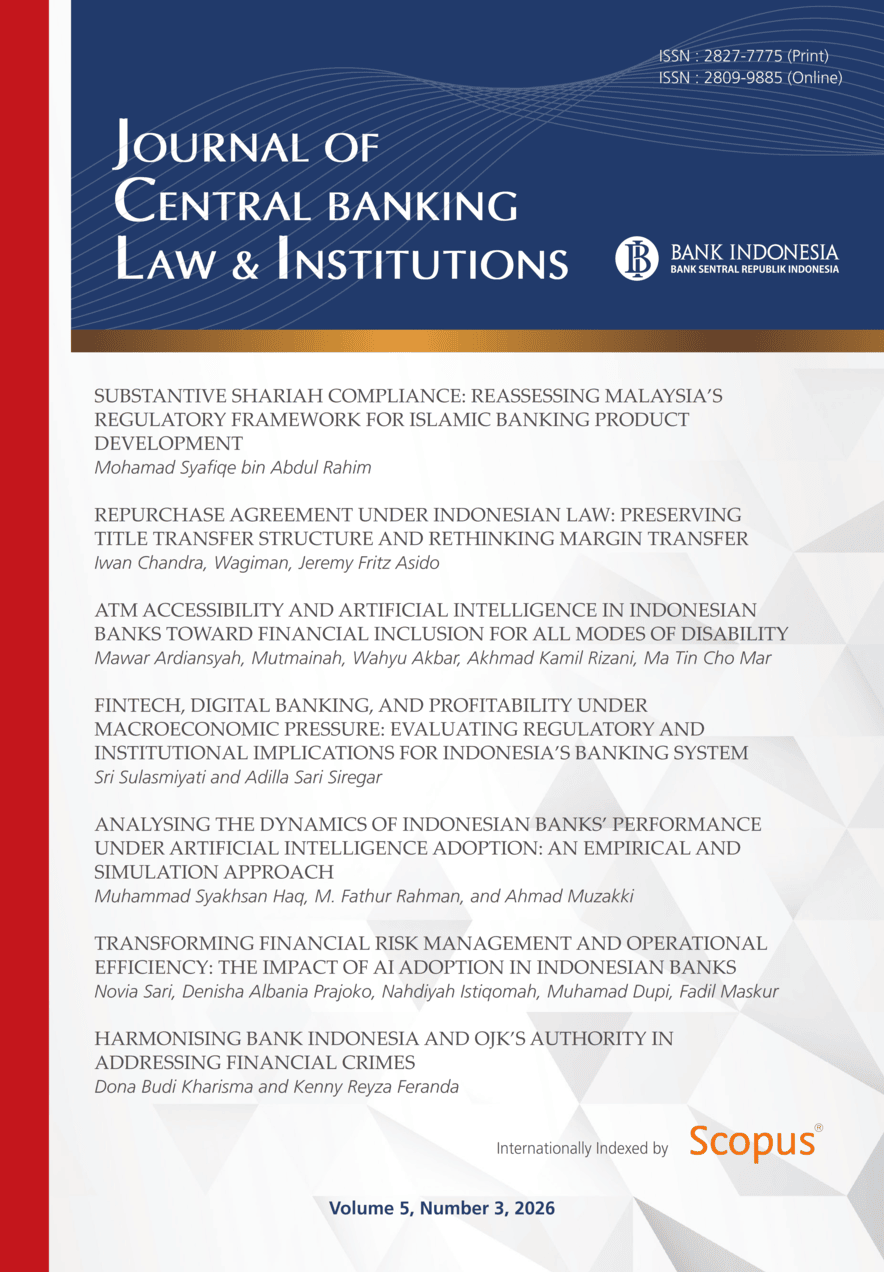
Analysing the Dynamics of Indonesian Banks’ Performance Under Artificial Intelligence Adoption: An Empirical and Simulation Approach
##plugins.themes.academic_pro.article.sidebar##

Downloads
##plugins.themes.academic_pro.article.main##
Abstract
This study analyses the impact of artificial intelligence (AI) on bank performance and financial stability in Indonesia using a combined empirical and simulation approach. Employing monthly panel data from 50 Indonesian banks during the period 2017–2023, the empirical analysis applies Feasible Generalised Least Squares (FGLS) and staggered Difference-inDifferences (DiD) estimators following Callaway and Sant’Anna to identify the effects of AI adoption. The results show that AI adoption increases Return on Assets (ROA) by 0.116 percentage points and reduces Non-Performing Loans (NPLs) by 0.068 percentage points, while AI chatbot implementation raises ROA by 0.189 percentage points and lowers the Loan-to-Deposit Ratio (LDR) by 3.18 percentage points. In contrast, AI training is associated with a short-run decline in ROA, reflecting implementation and adjustment costs. Staggered DiD estimates indicate that bank performance weakened during the COVID-19 period due to heightened liquidity pressures but stabilised in the post-pandemic phase, thereby contributing to improved financial stability. Complementing the empirical findings, a system dynamics simulation demonstrates that AI investments initially constrain profitability growth but yield accelerating gains over time through efficiency improvements and risk mitigation. Overall, the study highlights the importance of phased AI adoption and institutional readiness in strengthening bank performance and financial stability in Indonesia.
##plugins.themes.academic_pro.article.details##
References
- “The State of AI in 2025: Agents, Innovation, and Transformation.” McKinsey & Company. Accessed July 29, 2026. https://www.mckinsey.com/capabilities/quantumblack/our-insights/the-state-of-ai.
- Aguegboh, Ekene S., Chinonso V. Agu, and Vivian I. Nnetu-Okolieuwa. “ICT Adoption, Bank Performance & Development in Sub-Saharan Africa: A Dynamic Panel Analysis.” Information Technology for Development 29, no. 2-3 (2022): 406-422. https://doi.org/10.1080/02681102.2022.2131701.
- Amato, Alessandra, Joerg R. Osterrieder, and Marcos R. Machado. “How Can Artificial Intelligence Help Customer Intelligence for Credit Portfolio Management? A Systematic Literature Review.” International Journal of Information Management Data Insights 4, no. 2 (2024): 100234. https://doi.org/10.1016/j.jjimei.2024.100234.
- Armenia, Stefano, Eduardo Franco, Francesca Iandolo, Giuliano Maielli, and Pietro Vito. “Zooming in and out the Landscape: Artificial Intelligence and System Dynamics in Business and Management.” Technological Forecasting and Social Change 200 (2024): 123131. https://doi.org/10.1016/j.techfore.2023.123131.
- Babina, Tania, Anastassia Fedyk, Alex He, and James Hodson. “Artificial Intelligence, Firm Growth, and Product Innovation.” Journal of Financial Economics 151 (2024): 103745. https://doi.org/10.1016/j.jfineco.2023.103745.
- Bala, Bilash Kanti, Fatimah Mohamed Arshad, and Kusairi Mohd Noh. System Dynamics: Modelling and Simulation. Springer, 2017.
- Barboza, Flavio, Herbert Kimura, and Edward Altman. “Machine Learning Models and Bankruptcy Prediction.” Expert Systems with Applications 83 (2017): 405-417. https://doi.org/10.1016/j.eswa.2017.04.006.
- Barney, Jay. “Firm Resources and Sustained Competitive Advantage.” Journal of Management 17, no. 1 (1991), 99-120. https://doi.org/10.1177/014920639101700108.
- Bawono, Icuk Rangga, and Rangga Handika. “How Do Accounting Records Affect Corporate Financial Performance? Empirical Evidence from the Indonesian Public Listed Companies.” Heliyon 9, no. 4 (April 2023): e14950. https://doi.org/10.1016/j.heliyon.2023.e14950.
- Becerra-Fernandez, Mauricio, Milton M. Herrera, and Efrain Morales Correa. “Financial Profitability Model Using System Dynamics.” In Proceedings of the XII Encuentro Colombiano de Dinámica de Sistemas. Bogotá D.C., Colombia, August 2014.
- Beck, T., Chen, T., Lin, C., & Song, F. M. (2016). Financial innovation: The bright and the dark sides. Journal of Banking & Finance, 72, 28–51. https://doi.org/10.1016/j.jbankfin.2016.06.012.
- Bellardini, Luca, Pierluigi Murro, and Daniele Previtali. “Measuring the Risk Appetite of Bank-Controlling Shareholders: The Risk-Weighted Ownership Index.” Global Finance Journal 60 (2024): 100935–35. https://doi.org/10.1016/j.gfj.2024.100935.
- Berger, A. N. (2003). The Economic Effects of Technological Progress: Evidence from the Banking Industry. Journal of Money, Credit and Banking, 35(2), 141–176. https://www.jstor.org/stable/3649852.
- Born, Benjamin, and Jörg Breitung. “Testing for Serial Correlation in FixedEffectsPanel Data Models.” Econometric Reviews 35, no. 7 (2014): 1290–1316. https://doi.org/10.1080/07474938.2014.976524.
- Callaway, Brantly, and Pedro H.C. Sant’Anna. “Difference-in-Differences with Multiple Time Periods.” Journal of Econometrics 225, no. 2 (2021). https://doi.org/10.1016/j.jeconom.2020.12.001.
- Dell’Acqua, F., McFowland, E., III, Mollick, E., et al. (2023). Navigating the jagged technological frontier: Field experimental evidence of the effects of artificial intelligence on knowledge worker productivity and quality (Harvard Business School Working Paper No. 24-013). Harvard Business School. https://doi.org/10.2139/ssrn.4573321.
- Fujii, Motomasa, Hiroki Sakaji, Shigeru Masuyama, and Hajime Sasaki. “Extraction and Classification of Risk-Related Sentences from Securities Reports.” International Journal of Information Management Data Insights 2, no. 2 (2022): 100096. https://doi.org/10.1016/j.jjimei.2022.100096.
- Greene, William. Econometric Analysis, 8th ed. Pearson, 2018. https://api.pageplace.de/preview/DT0400.9781292231150_A39514649/preview-9781292231150_A39514649.pdf.
- Gunnarsson, Björn Rafn, Seppe vanden Broucke, Bart Baesens, María Óskarsdóttir, and Wilfried Lemahieu. “Deep Learning for Credit Scoring: Do or Don’t?” European Journal of Operational Research 295, no. 1 (2021): 292-305. https://doi.org/10.1016/j.ejor.2021.03.006.
- Gupta, Priyanka, Girish Lakhera, and Manu Sharma. “Examining the Impact of Artificial Intelligence on Employee Performance in the Digital Era: An Analysis and Future Research Direction.” The Journal of High Technology Management Research 35, no. 2 (2024): 100520. https://doi.org/10.1016/j.hitech.2024.100520.
- Gyamfi, Bright Akwasi, Ilhan Ozturk, Murad A. Bein, and Festus Victor Bekun. “An Investigation into the Anthropogenic Effect of Biomass Energy Utilization and Economic Sustainability on Environmental Degradation in E7 Economies.” Biofuels, Bioproducts and Biorefining 15, no. 3 (2021): 840–51. https://doi.org/10.1002/bbb.2206.
- Gyau, Emmanuel Baffour, Michael Appiah, Bright Akwasi Gyamfi, Theodoria Achie, and Muhammad Abubakr Naeem. “Transforming Banking: Examining the Role of AI Technology Innovation in Boosting Banks Financial Performance.” International Review of Financial Analysis 89 (2024): 102632. https://doi.org/10.1016/j.irfa.2024.103700.
- Hariguna, Taqwa, and Athapol Ruangkanjanases. “Assessing the Impact of Artificial Intelligence on Customer Performance: A Quantitative StudyUsing Partial Least Squares Methodology.” Data Science and Management 7, no. 3 (2024): 155-163. https://doi.org/10.1016/j.dsm.2024.01.001.
- Ikhsan, Ridho Bramulya, Yudi Fernando, Hartiwi Prabowo, Yuniarty, Anderes Gui, and Engkos A. Kuncoro. “An Empirical Study on the Use of Artificial Intelligence in the Banking Sector of Indonesia by Extending the TAM Model and the Moderating Effect of Perceived Trust.” Digital Business 5, no. 1 (2025): 100103. https://doi.org/10.1016/j.digbus.2024.100103.
- Iman, Nofie, Sahid S. Nugroho, Eddy Junarsin, and Rizky Y. Pelawi. “Is Technology Truly Improving the Customer Experience? Analysing the Intention to Use Open Banking in Indonesia.” International Journal of Bank Marketing 41, no. 7 (2023): 1521-1549. https://doi.org/10.1108/ijbm-09-2022-0427.
- Indriasari, Elisa. Harjanto Prabowo, Ford Lumban Gaol, and Betty Purwandari. “Digital Banking: Challenges, Emerging Technology Trends, and Future Research Agenda.” International Journal of E-Business Research 18, no. 1 (2022): 1–20. https://doi.org/10.4018/IJEBR.309398.
- Jeris, Saeed Sazzad. “Factors Influencing Bank Profitability in a Developing Economy.” International Journal of Asian Business and Information Management 12, no. 3 (2021): 333-346. https://doi.org/10.4018/ijabim.20210701.oa20.
- Königstorfer, Florian, and Stefan Thalmann. “Applications of Artificial Intelligence in Commercial Banks: A Research Agenda for Behavioral Finance.” Journal of Behavioral and Experimental Finance 27 (2020): 100352. https://doi.org/10.1016/j.jbef.2020.100352.
- Kumari, Bharti, Jaspreet Kaur, and Sanjeev Swami. “System Dynamics Approach for Adoption of Artificial Intelligence in Finance.” In Lecture Notes in Mechanical Engineering, 2021, 555–575.
- Leo, Martin, Suneel Sharma, and K. Maddulety. “Machine Learning in Banking Risk Management: A Literature Review.” Risks 7, no. 1 (2019): 29. https://doi.org/10.3390/risks7010029.
- Li, Yu, Huiyi Zhong, and Qiye Tong. “Artificial Intelligence, Dynamic Capabilities, and Corporate Financial Asset Allocation.” International Review of Financial Analysis 96 (2024): 103773. https://doi.org/10.1016/j.irfa.2024.103773.
- Li, Zhicheng. “Does Artificial Intelligence Enhance Bank Profitability? Evidence from China.” Finance Research Letters 90 (2026): art. 109366. https://doi.org/10.1016/j.frl.2025.109366.
- Moundigbaye, Mantobaye, William S. Rea, and W. Robert Reed. “Which Panel Data Estimator Should I Use?: A Corrigendum and Extension.” Economics: The Open-Access, Open-Assessment E-Journal, 2018. https://doi.org/10.5018/economics-ejournal.ja.2018-4.
- Naili, Maryem, and Younès Lahrichi. “Banks’ Credit Risk, Systematic Determinants and Specific Factors: Recent Evidence from Emerging Markets.” Heliyon 8, no. 2 (2022): e08960. https://doi.org/10.1016/j.heliyon.2022.e08960.
- O’brien, Robert M. “A Caution Regarding Rules of Thumb for Variance Inflation Factors.” Quality & Quantity 41, no. 5 (2007): 673–90. https://link.springer.com/article/10.1007/s11135-006-9018-6.
- Oxford Analytica. “AI’s Promise to Improve Policy-Making Comes with Risks.” Expert Briefings, November 15, 2024. https://doi.org/10.1108/OXAN-DB291026.
- Pesaran, M. Hashem. “A Simple Panel Unit Root Test in the Presence of Cross-Section Dependence.” Journal of Applied Econometrics 22, no. 2 (2007): 265–312. https://doi.org/10.1002/jae.951.
- ———. “Estimation and Inference in Large Heterogeneous Panels with a Multifactor Error Structure.” Econometrica 74, no. 4 (July 2006): 967–1012. https://doi.org/10.1111/j.1468-0262.2006.00692.x.
- ———. “General Diagnostic Tests for Cross Section Dependence in Panels.” https://doi.org/10.17863/CAM.5113.
- ———. “Testing Weak Cross-Sectional Dependence in Large Panels.” Econometric Reviews 34, no. 6-10 (December 17, 2014): 1089–1117. https://doi.org/10.1080/07474938.2014.956623.
- Rahman, Mahfuzur, Teoh Hui Ming, Tarannum Azim Baigh, and Moniruzzaman Sarker. “Adoption of Artificial Intelligence in Banking Services: An Empirical Analysis.” International Journal of Emerging Markets 16, no. 10 (2021): 4270–4300. https://doi.org/10.1108/IJOEM-06-2020-0724.
- Ramachandran, K.K., A. Apsara Saleth Mary, Shibani Hawladar, D. Asokk, Bandi Bhaskar, and J.R. Pitroda. “Machine Learning and Role of Artificial Intelligence in Optimizing Work Performance and
- Employee Behavior.” Materials Today: Proceedings 51 (2022), 2327-2331. https://doi.org/10.1016/j.matpr.2021.11.544.
- Riyanto, A., I. Primiana, Yunizar, and Y. Azis. “Digital Branch: Banking Innovation in Indonesia to Face 4.0 Industry Challenges.” IOP Conference Series: Materials Science and Engineering 662, no. 7 (2019): 072002. https://doi.org/10.1088/1757-899X/662/7/072002.
- Scardovi, Claudio. Digital Transformation in Financial Services. Springer, 2017.
- Schulte, Markus, and Adalbert Winkler. “Drivers of Solvency Risk – Are Microfinance Institutions Different?” Journal of Banking & Finance 106 (2019): 403–26. https://doi.org/10.1016/j.jbankfin.2019.07.009.
- Shiyyab, Fadi S., Abdallah B. Alzoubi, Qais M. Obidat, and Hashem Alshurafat. “The Impact of Artificial Intelligence Disclosure on Financial Performance.” International Journal of Financial Studies 11, no. 3 (2023): 115. https://doi.org/10.3390/ijfs11030115.
- Soueidan, Mohamad H., and Rodwan Shoghari. “The Impact of Artificial Intelligence on Job Loss: Risks for Governments.” Technium Social Sciences Journal 57 (2024): 206-223. https://doi.org/10.47577/tssj.v57i1.10917.
- Srijariya, Witsanuchai, Arthorn Riewpaiboon, and Usa Chaikledkaew. “System Dynamic Modeling: An Alternative Method for Budgeting.” Value in Health 11 (2008): S115-S123. https://doi.org/10.1111/j.1524-4733.2008.00375.x.
- Stiglitz, Joseph E., and Andrew Weiss. “Credit Rationing in Markets with Imperfect Information.” The American Economic Review 71, no. 3 (1981): 393–410. https://www.jstor.org/stable/1802787.
- Teece, David J., Gary Pisano, and Amy Shuen. “Dynamic Capabilities and Strategic Management.” Strategic Management Journal 18, no. 7 (1997): 509– 533. https://doi.org/10.1002/(SICI)1097-0266(199708)18:7<509::AIDSMJ882>3.0.CO;2-Z.
- To, Hon Kiu, and Kin Wai Chan. “Mean Stationarity Test in Time Series:A Signal Variance-Based Approach.” Bernoulli 30, no. 2 (May 1, 2024). https://doi.org/10.3150/23-bej1630.
- Wooldridge, Jeffrey M. Introductory Econometrics: A Modern Approach. Cengage Learning, 2013.
- Zolfagharian, Mohammadreza, Georges Romme, dan Bob Walrave. 2015. “Combining System Dynamics Modeling with Other Methods: A Systematic Review.” Proceedings of the 59th Annual Meeting of the ISSS 1, no. 1. Berlin, Germany: International Society for the Systems Sciences. https://www.researchgate.net/publication/298774080.

This work is licensed under a Creative Commons Attribution-NonCommercial-ShareAlike 4.0 International License.